A Valentine’s Day Tribute

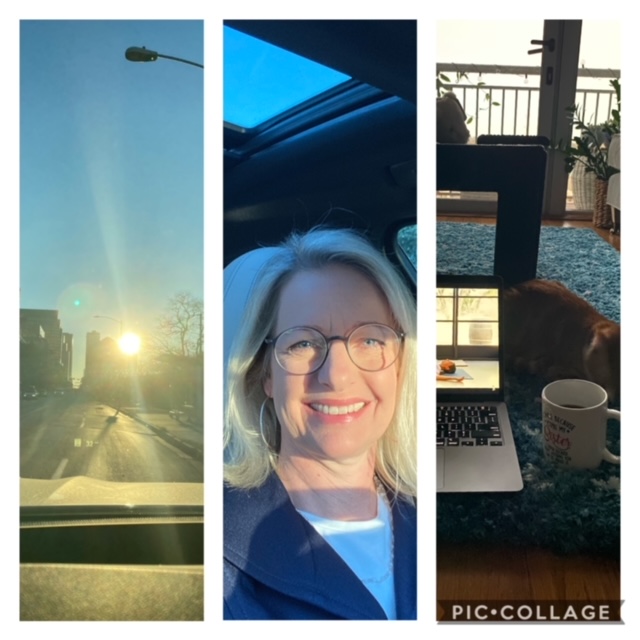
Tonight, my Valentine is alone in our house in Grapevine having cooked his own birthday dinner and eaten a cake that his parents gave him yesterday. I’m perched in my apartment in Austin watching sleet and snow fall onto the icy streets below. It’s a weird arrangement we have. Our poor children have given up trying to explain their parents to their friends, and now that we’ve been living this way (fairly happily, I’ll add) for the better part of 8 months, I think they finally believe that their parents’ marriage is not on the rocks.

If I’m doing the math right, this is our 32nd Valentine’s Day as a couple. Married for 28 of those, and close friends dating back to years 33 and 34. Our early days weren’t rosy enough to fit neatly into one of those “How we met” social media posts that are going around. Not because of why you might think. For some reason this year, it feels right to be a little vulnerable here and give my sweetheart a little tribute.

You see Miles had a roommate in college, and I was dating him during my freshman year. Things were going as you might expect it to be going for a couple of small town Oklahoma kids finally free from curfews and other inconveniences. There were parties and other sorts of college antics…. and then there was his temper. Even 34 years later, I can still picture the look in his eyes and recall the sound of his voice when he got jealous or annoyed. Since this blog is my happy place of reflection and healing, I’ll not detail the dangerous nature of this relationship, but I want to include enough detail for readers to know that 1) abusive relationships take many forms and can happen to absolutely anyone, 2) there is always a way out to safety, and 3) my Valentine of 32 years was largely responsible for my path to safety.

Miles is stubborn in a way that would make many mules jealous. While that trait has led to more than a few rough patches throughout our decades, he applies that same resolve to his tightly held values of loyalty and help for those in need. And help was what I needed during the year that he lived with my boyfriend.

After a breakup that involved the local hospital, I began to heal. Slowly. But with a determination that marked a clear beginning of the adult chapter of my life. And Miles and I became closer and closer friends. Surviving a year with that level of intensity resulted in a bond that surprised us both.

And now here we are. Lots of years, lots of seasons, lots of cities, homes, tears, mistakes, memories, scars, and laughter later. We have two amazing children and two adorable cats (Miles would disagree on this point for the record). He has supported me in my career and and has consistently been a safe place for me to heal and live and thrive. He’s low maintenance, low drama, and he works his ass off at everything he decides to do.

As I sit in my Austin apartment, employed in a city I love, doing work that is a calling, there is a caring, patient man at home 3 hours away taking care of my countless plants and overlooking the fact that he got not even so much as a card on his Valentine’s birthday. I am a very lucky girl.

Hopefully, this blog post brings him a smile and a little bit of pride in the role he has played in making our family what it is. Thanks, Valentine. And Happy Birthday. See you later this week.

Birthdays These Days

For those who’ve known me long enough to have read my inaugural blog post in 2019, you may know that February 1st has baggage for me. I guess everyone has some degree of positive or negative weight associated with their birthday, but for adoptees, it’s just a wee bit more complicated. It’s a little like one of those “How it started/How it’s going” memes with a few extra stages in the middle.

Early childhood- “Woo hoo, I love birthdays! I get presents and lots of attention!”

Teenagehood- “Thank the Lord I can drive, leave home, drink, etc…”

Young adulthood- “Hmmm, this isn’t quite as big of a deal as it used to be.”

30, 35, 40, … “Wow, these milestone birthdays seem to come around often…”

50- “I think I’ll start a blog and open my soul to the world.”

Today- scrolls through phone and social media and thinks… “I wouldn’t trade this journey for the world.”

I may have actually reached the point in my life that I’m able to truly cherish the many years that have added up to today. My messages today came from friends on different continents, friends from elementary school, close family and distant relatives, former colleagues from multiple school districts, friends in every city I ever called home, new friends in my new city and workplace, and perhaps most poignantly, my new siblings that have become such important people in my life. It was like a slow motion episode of “This Is Your Life.”

As described in my 2019 birthday blog, this day used to be clouded by the longings of a child in want of biological answers. Now that I have those answers, however bittersweet they are, I can celebrate all the beauty of my adopted life, my independent adult life, the family Miles and I have made together, and the newly found missing pieces of my heart – my bio dad’s son, Tom (and his awesome wife, Cari), and my bio mom’s three children, Katie, Betsy, and Joe (along with their amazing dad, Dave, 6 nieces and nephews, and a great brother in-law, Pat).

I can honestly assess my birthday well being today and describe it as light hearted, reflective, and grateful. In a year where these words have been far too scarce, I’m going to fall asleep with a smile on my face tonight and call that a very big win. It really has been a happy birthday.

Election Eve

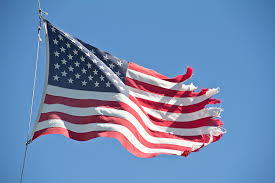
At the end of the 2016 election season, one of the few things Americans could agree on was that we were all sick of campaign commercials. There was a collective on-edgeness because of the potential for history to be made with our first female president or history to be made by a reality TV star being elected to our nation’s top office. The lead up to election eve had been one of the most contentious in history. The seams holding together our stars and stripes were a little frayed.

Have you ever known a person who could tell you every detail of what they did on the second Saturday of January 2018? The kind of person who remembers names, dates, and the directions to your house after they’ve been there only once? It’s safe to say I’m not one of those people. I have an “ish” kind of memory. My mind tends to catch the gist and then move on to the next scene of interest. But on the night of the 2016 election, my memories are freakishly distinct. I sat alone on my worn brown leather sofa eating a dinner of leftover pasta after work. Preliminary reports on several TV stations were reportedly in Hillary’s favor (maybe these were the results of early voting?). But around 7:30, a few key states were called in favor of Trump. And then a few more. The text thread between a few close friends and me went from lively and anticipatory to radio silent. I remember looking at my phone to see if it was still on. In my mind, I pictured all of us on our own living room couches staring at our televisions in shock. I didn’t want to turn off my TV. I kept praying that there would be a miraculous uptick in states called for Hillary. Or a report that some box of ballots had just been discovered and the results were now being updated. Around midnight, I began to curse the electoral college.

The next morning’s drive to work was downright eerie. There were few cars on the road. I didn’t have the mental energy to listen to the radio. As I crossed the paths of like-minded colleagues throughout the day, only looks were exchanged.

The results of the 2016 election may be hard to contextualize for my daughters who have lived through only a few presidents and have scant memories of the good old days of “normal” political jousting (pre-Twitter). But now, an entire generation of young people just received a civics lesson from the executive branch of our government that will be sure to have an impact for generations to come.

Much has changed since November 8th of 2016. As I consider what the next 48 hours will hold, it feels important to reflect on four of the wildest years in American history. I hope the blog post I write in 2024 will have more good things to say, but in any event, this feels important to capture – if only for myself.

Prior to the 2016 election, news media was fairly polarized, but the people I know often skipped around between networks to get a more complete picture of issues. During the 2016 election and afterward, America has lived in 2 realities – those who watch Fox News and those who do not. The purpose of this blog is not to catalog the differences among networks, but rather to point out the successful discipleship of this network to rationalize Donald Trump’s misbehavior in ways that would have been unthinkable in the past. On a personal level, I feel like I’ve lost friends and family members not to a medical prognosis or a move to a faraway land. Rather, I’ve lost them ideologically because they’ve bought into the notion that any news other than what Fox broadcasts must surely be “fake.” During the past 4 years, I have gained a whole new understanding of the importance of having a free press. And I’d be remiss if I didn’t point out the similarities between the “fake news” rhetoric and propaganda of the last four years to the exhibit I walked through in the World War II museum recently.

The first time I heard the ‘Make America Great Again’ slogan, I remember thinking – that’s kinda gutsy. The guy is coming right out and saying that today’s America is not great. And then I thought about it a bit more and wondered – what version of America’s past are we trying to regenerate? The period when women didn’t yet have the right to vote? The period before the ADA became law and our country became more systemically committed to equitable access regardless of physical ability? The period when Black students had to go to segregated schools and their parents had to sit at the back of the bus? The period before technology when every bit of knowledge that existed in the world could be contained in the annual production of the World Book Encyclopedia that we all loved to page through in the library? The period before it was legal to marry your life partner, regardless of their gender? Over the past four years, it has become clear that Trump’s version of great means that universal healthcare will no longer exist. That a woman’s dominion over her own body is decontextualized and subject to lawmakers’ whims. That discriminatory practices related to sexual preference and gender identity are not only allowed but legalized. That during the biggest health crisis of our generation, the scientists in charge of advising Trump are routinely muzzled and discredited at every turn – resulting in the USA being a shining example of how NOT to respond to a global pandemic. That Black citizens will be subject to police brutality and structural racism that is unchecked by the Commander in Chief, and in some cases encouraged by him. While it may be too long to fit on a ball cap, I think I’d prefer a slogan that said ‘Make America Be Like It Was in 2015 Again.” I can think of a long list of things off the top of my head that were far better then than they are today.

I learned the word misogyny in the last couple of years. As a lifelong word nerd (and also, um, a female), I find it bizarre that this word was never a part of my vernacular. I guess maybe that’s a good thing? But when a male I know first used the word in a sentence, he must have noticed my puzzled look, and he seriously had to define it for me. (Yes, I’m kinda embarrassed by the irony of this, especially since this particular male had many of the traits of a classic misogynist.) Trump’s unapologetic disregard for women and his sexual shenanigans that make the events of 1998 in the Oval Office seem tame have buried the bar for male decency. Working in public schools, I have seen first hand the impact this crass behavior has had on young men. I can only hope that the future holds a series of principled leaders who, regardless of their gender, demonstrate value and respect for the vast contributions of women.

Before 2016, I was an active member of my church. I led Bible studies. I attended services. I enjoyed living a life filled with the hope of drawing others to Jesus through my church-related pursuits. And then Trump hijacked Christianity. I don’t know of any other way to say it. Through the irrational support by many Christian leaders, churches have become battlegrounds fraught with racist ideology, misogyny (see what I did there?), and a fear-based rhetoric that even non-Christians can see is the picture of irony given the fact that “do not fear” is the most common command in the Bible. In a recent intake questionnaire I had to complete, the question “What is your religious affiliation?” stared me down. After a while, I threaded the needle by saying, “I follow Jesus. I’m disgusted by most organized religion right now.” The Jesus I know would be wearing a mask and upending every table in the White House (and on Capitol Hill too, if we’re being honest).

It is clear that Trump’s “Pro Life” agenda was a key driver in his endearment to mainstream Christian leaders. Again, the irony here is thick, given the unabashed sexual exploits of this man by his own admission. (I wonder if he knows where unplanned pregnancies come from?) As the product of an unplanned pregnancy that was (speculatively) saved due to the prohibition of abortion before Roe v. Wade in 1973, I feel entitled to a bit of an opinion on this topic. I believe that abortion is not the best solution to the difficult choice women must sometimes face due to their reproductive capabilities. HOWEVER, until decision makers demonstrate the same level of self-righteous determination to save ALL imperiled lives in this world, it is downright hypocritical to meddle in the personal decisions of women who will be the ones living with the reproductive consequences. Take for example Trump’s behavior in other life or death related matters… The number of lives lost in this pandemic due to his disregard for science. The number of lives ruined because of irresponsible border control policies and practices leaving many children still hoping for reunification with their families years after the separation practices began. The numbers of lives imperiled as a result of the draconian and racist refugee policies that have characterized this administration. I can definitely get on board with “Pro Life” policies, but only if we’re going all in.

Prior to 2016, I participated in several book studies and professional learning events designed to help educators help students address bullying situations. We learned about the lifelong pain of those who have been bullied (and all too often, the suicidal outcomes), about the psychology of bystanders who choose not to intervene, and we learned about the pain and insecurity deep within bullies that often feed their behavior. And then we elected Donald Trump. In a normal, pre-2016 universe, the connection here would have been obvious. But… 2020. This weekend, I walked around with my mouth agape at the degree to which the “bullying is bad” bar has been lowered. In my home state (God Bless Texas), Joe Biden’s bus was surrounded on a highway and nearly run off the road by a caravan of Trump flag wielding trucks. It was like a highway, high-stakes version of what we tried to prevent in the 7th grade hallway. I temporarily lost my mind and posted the video (and my lack of words to even describe what I was seeing) to my Facebook feed (one self-care rule I’ve tried to uphold is minding the positivity ratio that I communicate). In what shouldn’t have been surprising, but I guess my glass half full-ness still has a little gas in the tank so it still surprised me, a couple of my longtime friends chimed in cheering the behavior on and/or justifying it by citing the “crazies” on both sides. In another “lost my mind” moment, I began sparring with those who thought this behavior was ok. I felt like the bystander that had just walked between the bully and his target. Sweaty palms, jittery eyes, but a strong spine. And I spoke my truth. Respectfully, I hope. Without expectation that a mind will be changed. But after 1,457 days of this presidency, I’ve finally learned how to and when to speak my truth without becoming a bigger part of the problem. (A back door silver lining, perhaps?)

In a recent Brene’ Brown podcast interview with Joe Biden, he cited one of the adages he’d heard growing up, “Who you are is how you live.” When I think back to the sense I had of the frayed stars and stripes in 2016, I realize that who we are and how we are living in America is putting more and more strain on the fabric and seams of our country. I’m praying that Wednesday dawns peacefully and provides hope that can bind up the frays and holes within our hurting nation. I hope you’ll join me.

My New Water Bottle Trophy

The day after I finished defending my dissertation, my ever-so-helpful children reminded me that I’d claimed I’d start working out again after I finished my doctorate. “What are you going to do, Mommy?” they asked.

While I wanted to respond with, “Crawl in bed and sleep for two years.” I also wanted to remember what it felt like to take care of myself. For 4 years, I’d written and studied and juggled in order to obtain this degree, and eating right, sleeping amply, and fitness of any sort were not high on my list.

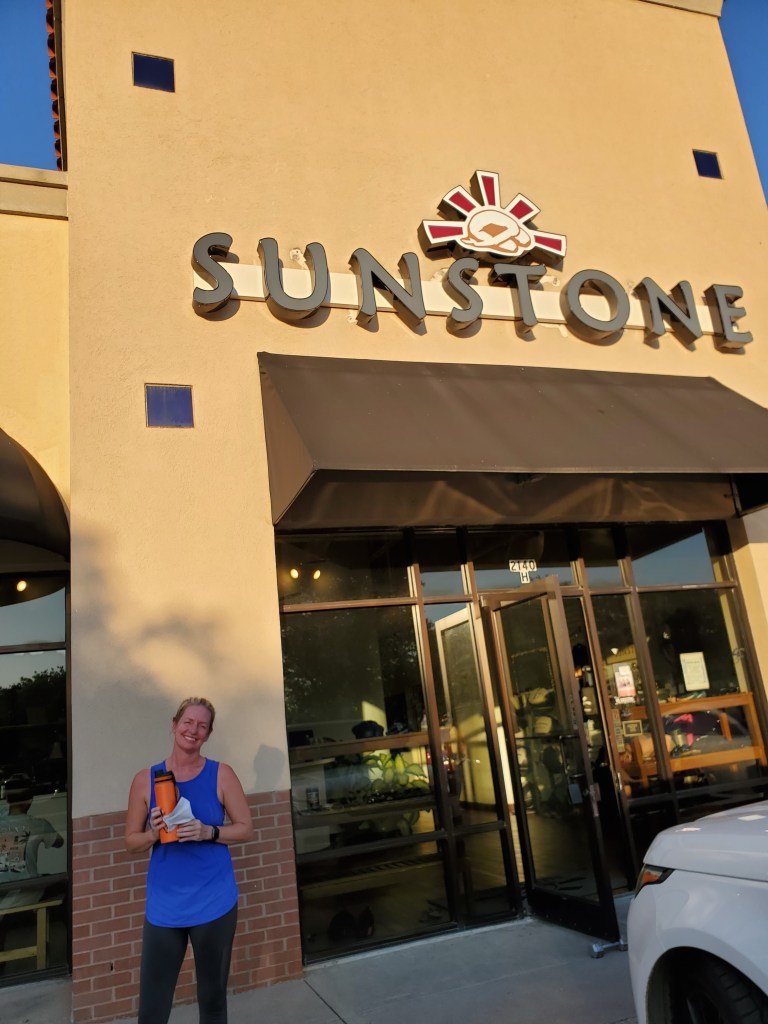
So on July 3, 2013, I walked into Sunstone Studio and took my first yoga class. It was hot. I was out of shape. I didn’t speak the language. But the teacher was encouraging. And no one laughed at me. And I felt oddly refreshed after the 60 minute experience of raining sweat. So I went back. And I went back. And I went back again.

I decided to set myself goals for completing “x” number of classes and rewarded myself with a purchase from my favorite fitness clothing store when I reached each benchmark. This helped. As the classes added up, my practice strengthened, and my wardrobe options expanded. Before I knew it, I’d celebrated my 100th class by the end of December in that first year. Since then, my pace has slowed and quickened intermittently. I’ve hit goals of 350 and 500 classes, and tried every sort of class type they offer. Most I like, a few I don’t, and I’ve reached the point that I can now recognize what type of class my body most needs… Pilates? Barre? Hot yoga? Flow? Power flow? Core? HIIT? Pure flow? And even Hot Yoga Lite has a time and place. Like different prescriptions, they challenge me, push me, heal me, cleanse me, and strengthen me.

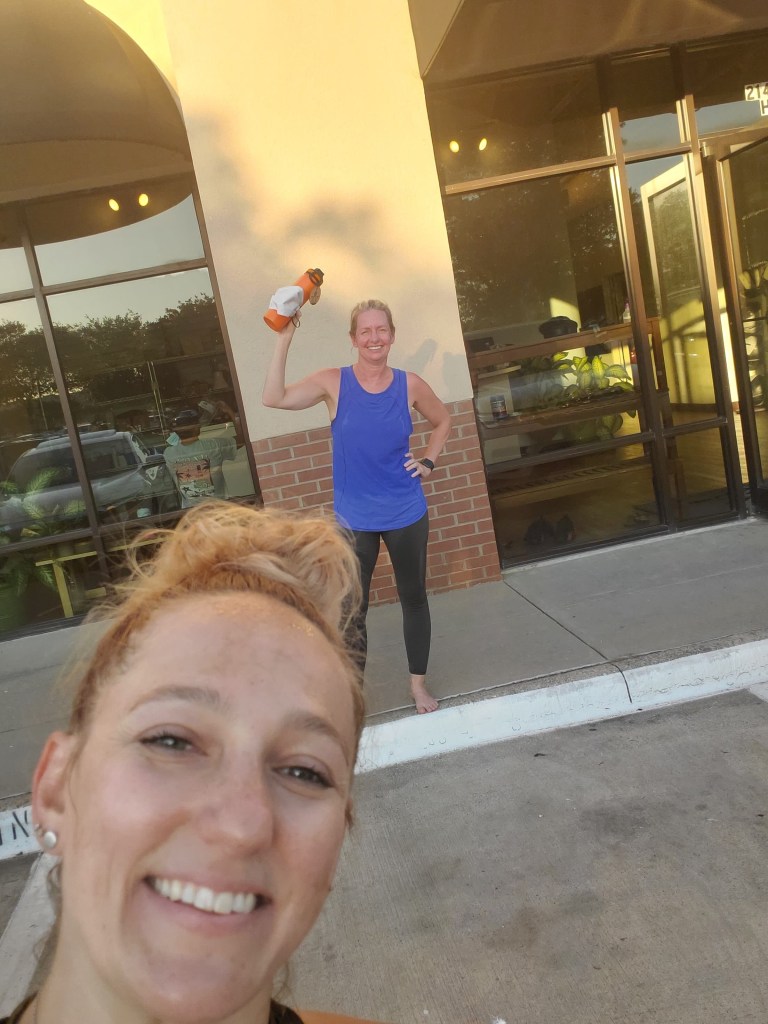
Tonight, I completed my 1,000th class!

Through this practice I now love, I’ve learned lessons that transcend the studio. Life outside the room is often a complete circus. Inside the room, on my 2 ft by 6 ft rectangle, I am safe. This 60 minute gift to myself serves as a place to block out the chaos, focus on that which I can control, clear my head, and gain perspective. It’s a perk that I burn calories and build strength, and while those reasons are why I started, they’re not the reasons I continue.

In yoga, focus is critical. Balance and fluidity of movement aren’t possible without it. Outside the studio, focus has become equally important for me. Without a goal, target, or something to ground me, I work untethered – staying busy, but not connected to a purpose. Life in the studio, focused on whatever it takes to get me through a balancing posture or a hard interval in HIIT, has taught me the value of focus in work, in my family, and in my life’s goals.

During the 7 years since I started at Sunstone, I’ve had a few dozen different teachers. Nearly all of them have been amazing. After each class they send students a survey to gather feedback on the experience, and in the few times I’ve responded, it was clear the teachers had read and were improving based on the input. On a tiny handful of occasions, I have had a teacher who was less careful with word choice in the class. Whether it was framed as sarcasm or as words that were more glass half-empty in spirit, these instances were such a departure from the language norms of encouragement, positivity, or specific feedback on necessary adjustments that they stood out and served as distractions. They made me realize how much I thrive on the well chosen words of supportive teachers. From this experience, I’ve tried to recognize how powerful words are outside of the studio. Are the things I say building up or tearing down. Are the corrections I give specific and actionable or general and defeating? I don’t always win this game, but the lesson has taught nonetheless.

Consider the intentional use of the word “practicing.” I’ve now learned that yogis don’t DO yoga. They PRACTICE yoga. There is such an important difference in how that is couched and the meaning it brings to the experience. There are no failures on the mat. Falling out of a posture has taught you a lesson about where your boundaries currently exist. And that serves to inform your next attempt. The practice is what matters. Nearly each class follows the same sequence each time it is conducted. The growth here comes from experimentation and stretching within the known boundaries of the sequences. In the predictability, there is freedom to explore. That little lesson continues to teach me in ways I don’t even yet fully comprehend.

Life in 2020 is hard. This, as we know, is an understatement. As we survive quarantine, attend protests, manage family dynamics, navigate uncertainty, and face financial and health challenges, sanity is elusive. During the shelter-at-home stage of the pandemic this spring, I lost access to this sanctuary. Bless my family’s heart is all I can say. Did you know that chandeliering is a verb? (Thank you, Brene’ Brown!) It wasn’t until my tool for completing the stress cycle was gone that I even knew what this phrase meant and how important my practice was to doing it.

On this night that I proudly hoisted my new orange Sunstone water bottle – the gift they present to their 1000 class students- up into the air like a trophy, I challenge you. Much like my girls did in 2013, “ What are you going to do?”

I can’t wait to read your blog post 7 years from now!

Thanks, Jesica!!!

Choosing something

“Unless someone like you cares a whole awful lot, nothing is going to get better. It’s not.” Dr. Seuss

I bought a Black Lives Matter t-shirt this week.

I used to think it was only extremists who wore shirts like that. I used to think people who wore those shirts were anti-police. I used to think Colin Kaepernick was unpatriotic by kneeling.

But then I started reading about the lives of Black people. I learned about implicit bias. I learned about systemic oppression. The implications of the GI Bill blew my mind. I watched as my Black friends had to choose their words more carefully than I did. I read the posts of my friends of color who experienced first hand profiling and discrimination by people who looked just like me.

And I started to get embarrassed. Ashamed of all the societal privilege that my white middle class upbringing had kept me from seeing.

I have several friends who are police officers or the spouses of police officers. The bravery it takes to serve the world in that role (as either the officer or the spouse) humbles me. They face incomprehensible dangers every single day. I would hate it if my words ever conveyed anything but respect for this calling. But there are some in uniform whose twisted view of their melanin supremacy manifests as abuse – with badges as weapons. The impact of this skewed world view has gone so far as to result in a state curriculum mandate requiring lessons for all teens on how to behave when being pulled over by a squad car. Let’s be honest, the point of this mandate is not for my white daughters. It has led to headline after headline of Black humans who have died violently at the hands of those who have sworn to protect.

A few years ago, I am embarrassed to say, I was a voice in the chorus of those saying things like, “there are two sides to every story.” But the examples now piled like a mountain of revealed bias are beyond coincidence. A few from the too-long list…

Eric Garner had just broken up a fight, according to witness testimony.

Ezell Ford was walking in his neighborhood.

Tanisha Anderson was having a bad mental health episode, and her brother called 911.

Tamir Rice was playing in a park.

Walter Scott was going to an auto-parts store.

Bettie Jones answered the door to let Chicago police officers in to help her upstairs neighbor,who had called 911 in order to resolve a domestic dispute.

Philando Castile was driving home from dinner with his girlfriend.

It’s unlikely that any officer leaves home with conscious intent to kill people of color, however the lack of something…. whether it’s preparation, protocols, empathy, or accountability to society… has led that to be startlingly common. And while the current riots were sparked by the inhumane treatment of George Floyd, the world is not short on non police-related examples of race-based misdeeds. In schools. In department stores. In courts. In hospitals. In government. In real estate. In virtually every walk of life, people of color live a different reality than I do. For those lacking understanding about the current anger and apparent recklessness, I’d ask you to consider spending every day of your life in the shoes of a dark-skinned individual and then reconsider how angry and reckless you might begin to feel.

I may lose the respect of some of my friends who read this or see me in the t-shirt I intend to wear proudly and boldly in my suburban neighborhood. I may provoke emotion of my readers who misread this as disrespect for first responders. I hope not. But if so, it’s a price I’ll gladly pay for the discomfort and reconciliation our nation desperately needs and won’t ever experience through silence. Whatever non-silence looks like to you, I implore you to do it. From a simple post on a social media platform that joins the chorus of social pressure for change to any number of self-educating/advocating strategies you choose. But please, just choose something.

“We know through painful experience that freedom is never voluntarily given by the oppressor; it must be demanded by the oppressed. Frankly, I have yet to engage in a direct-action campaign that was ‘well timed’ in the view of those who have not suffered unduly from the disease of segregation. For years now I have heard the word ‘Wait!’ It rings in the ear of every Negro with piercing familiarity. This ‘Wait’ has almost always meant ‘Never.’We must come to see, with one of our distinguished jurists, that ‘justice too long delayed is justice denied.’” Martin Luther King, Letter From a Birmingham Jail

Someday, Broadway

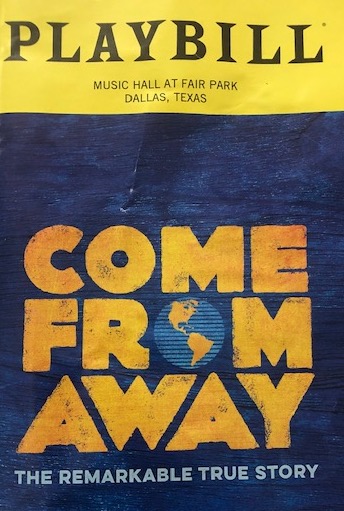
The more I reflect on the COVID-19 crisis, the more thoughtful I’ve become about how I spent the evening of March 12th. On this night, a dear friend and I spent a couple of hours experiencing a musical, Come From Away, at the Music Hall at Fair Park. Any other year, spending a mid-March evening with a friend at a musical would be unremarkable. This year, for reasons that anyone alive right now can imagine, enjoying a musical on that date in a public place in the pre-social distancing era earns remark.

This musical tells the story of 7,000 airline passengers who were unexpectedly grounded for six days in Gander, Newfoundland, a town of only 10,300 people, while traveling across the Altantic on the morning of 9/11/01. I’d read a book, The Day the World Came to Town, by Jim DeFede, a few years ago which detailed the story upon which this musical was based. It provided a fascinating narrative that left me moved by the power of the human spirit, the kindness of total strangers, and the ability for relationships and community to form out of times of crisis. As I sat in the audience that night, on edge for the sound of anyone coughing or appearing sick near where I was seated in the crowded theatre, I began to wonder. Could the drama surrounding the biggest crisis in my lifetime to this point – September 11, 2001 – be on the brink of being repeated in a new way nearly 19 years later? I distinctly remember wondering whether the events unfolding in March of 2020 would someday become a musical I’d go to see.

Engrossed in the Come From Away story, I fell in love with the characters. The shock of the world’s change that unfolded for them in waves of unbelievable news, the way they grappled with the devastation and personal connections to death and destruction, the diversity of people whose only common act was flying aboard one of the 38 planes which had to land on the small island that fateful day, and the genuine and selfless love offered by the humans who opened their arms and homes to the distraught passengers. It was the kind of show that makes you want to make friends with all of those who walk past you during intermission.

One of my biggest takaways from the musical was the capability of humans to rise above difference to survive in difficult circumstances. If ever our world has needed to experience this again, it is in 2020 – not just in Gander, but in Grapevine, New York City, Washington D.C., Stillwater, Hong Kong, Paris, and every other corner of the world. Political divisions, racial divisions, religious divisions, and the general tendency toward judgement rather than empathy has tempted me to lose faith in the world my children will inherit.

While I had no way of conceiving what the next few hours, days, and weeks could have held, Come From Away made me wonder what impact the looming COVID-19 pandemic could have on society. Seven weeks into a near-complete societal closure, I’m starting to see the answers.

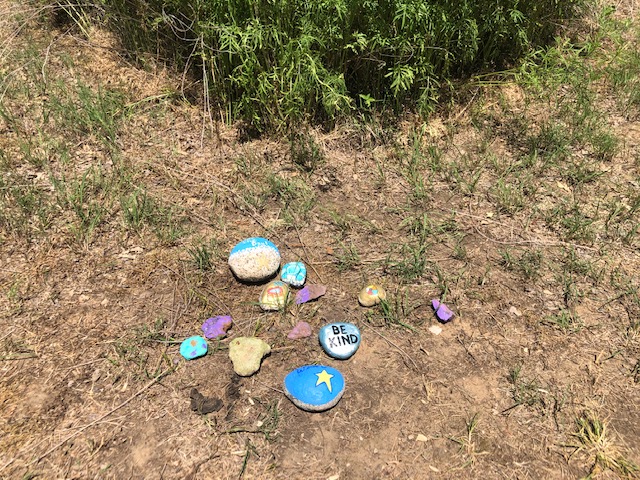
On my 2-3 daily walks around town, people wave. They smile….earnestly. As if genuinely wanting to see me and connect. Today on a walk along a pathway in the woods near my house, all walkers shared a kinship. A teenager biking alone slowed down and said “How are you today?” And he waited for my answer. A mother of 5 children – two in a stroller, two on scooters, one on a bike with training wheels – walked wearily down the path and chatted gratefully as my friend and I applauded how well she was doing with a small classroom of a family. At the park we passed, several dads were pitching balls to young children who tried hard to connect the bat. Freshly painted rocks with messages of hope adorned a fork in the path.

The U.S. mail service has actually delivered letters to my house and the houses of many I know. Real letters. Not just bills or perfunctory holiday announcements or catalogs. I’ve received kind, handwritten sentiments from those within my daily circle and those who I’ve not seen in years. The inability to connect in physical spaces has brought about more intentional connection via the mail, phone calls, porch drop-offs, virtual web meet-ups, and more. People clearly need each other. And the people with whom I’m connecting are not talking about politics, or race, or religion (although God and our need for His help has often been a subtext). They’re talking about how we’re doing. Care and concern about heatlth, ample food and toilet paper (seriously), and worries about anyone who may be lonely or in any type of danger.

My family of 4 is cohabiting under one roof for multiple weeks for the first time since mid-2017. During the fall of 2016, we downsized homes in somewhat early anticipation of being empty nesters. We built the house in a way that my two daughters could come back and visit for a few nights and not be uncomfortable, but we failed to anticipate a need for space to accomodate 4 people working on simultaneous Zoom and Webex calls during the day who would need to agree on one TV program in the evening. But we’ve managed. In fact, most of the time, we actually like each other. I feel like I now know my adult daughter in a way I hadn’t known her when she last shared my address. Her college classes I’ve eavesdropped on are HARD. And she knows how to do all these things no one in my family could have taught her. And she gets up and “goes” to her classes conscienciously. She’s missed her college life and the independence that came with it, no doubt, but she’ll be a great adult. I also now feel more confident sending my high school senior into the world of college because of what kind of human I’ve now seen her be. Yes, I lived with her daily for 17 years. But between her school and social schedule and my work and adulting schedule, I can count on two hands the number of truly quality minutes we’ve had together daily during the past year. The pandemic changed this. I now know her self-discipline, her integrity, her compassion, her study habits, and her needs. She’s going to be such a great college student and future adult. I know this now in a way that I wouldn’t have gotten to see before the world came to a screeching halt.

And the teachers… both the ones who have degrees and certificates on the wall and the ones whose normal titles are Mom or Dad, Sister or Brother, Grandma or Grandpa. All of these saints, learning how to make sure the routines for children’s learning continue in the face of nearly impossible circumstances. They are the ones dealing with motivational issues, correcting papers, tantrums, routines, tech challenges, balancing learning time with recess… all while possibly trying to hold down a virtual day job and processing the fear and uncertainty that every day’s news brings. But they’re doing it. Even my district’s campus with the most students in economic need has been able to connect with every single child. Families are struggling, but more than ever, the fabric of public education is being revealed as one of the great safety nets of our civilized society. Education will never again be the same after COVID-19, but in many ways, it may be improved and most definitely more appreciated.

My garden is growing. Every day I get to see new sprouts like the leaves of spinach growing outward in a way I never appreciated when my pre-washed salad was pulled out of a bag. I’m eagerly anticipating the varieties of tomatoes that will soon be ripe, and I can’t wait to share them with my neighbors who are also talking to me about my garden on their daily walks. I noticed a fox pacing my backyard yesterday while I looked out the window during a Webex call. He seemed perfectly at home. It occurred to me that he may be more at home than I’ve ever taken the time to realize. It’s me who is the newcomer to the property on a weekday afternoon.

Strangers are being kinder to each other. Last year, after a few examples of vitriolic tirades against my hard-working school district colleagues on the Nextdoor App, I’d stopped perusing it. One night last month I saw a notification about an area closure that caught my attention, so I clicked. Pleasantly surprised, the first post I saw came from a resident who needed help picking up groceries because of his underlying medical condition. Within a few hours, 26 strangers had responded with offers of porch drop-offs, donations, and other services. Thinking this to be an isolated instance, I scrolled on and saw several more examples of the app becoming a hub for neighborhood exchanges, offers of help, and encouragement.

Many awful statistics characterize the current crisis. The number of those infected and those who have lost their lives is staggering. The unemployment numbers, sales tax revenues, oil prices, and countless other measures have and will continue to have a devastating effect on the U.S. and world economies. Many have lost their homes and have food insecurity in numbers not seen since the Great Depression. These circumstances terrify me and keep me up at night wondering how to help or what the ripple effects will be for years to come.

Not being able to control any of the items listed in the prior paragraph is a source of great anxiety. I wonder if the real life community members of Gander, Newfoundland felt the same way. All they could do is put one foot in front of the other and show up as a human each day, working together and trying to do the next right thing. One day, the science will catch up with the crisis. One day, we’ll have a vaccine. One day, we might just have a musical about the COVID-19 pandemic. I hope the steps I take each day will make it one to inspire others, one that will show the good in humanity, and one that will reveal what is possible. Let’s pre-order our tickets.

Wordless

The role of a writer is not to say what we all can say, but what we are unable to say. – Anais Nin

For ages I’ve dreamt of a pause in life. Time to reflect, notice, cherish my family, my home. If only I could just have a few days or weeks to catch my breath, I thought. Time to write my book. Time to write letters. Journal. Let out all the words that fill my head, jumble my coherent speech, and even creep out as I type unconsciously as I go through my days – a quirky subtext to my life.

I think in paragraphs, revising incessantly. Admiring new words overheard, celebrating people’s word choice when something catches me by surprise. Language is my paintbrush. Was my paintbrush.

Once life’s great pause finally came…

My words have been stuck in my throat, too big and hard and scary to let out.

This is not the break I wanted. Each day I wake up hoping it will have just been a nightmare. Each day as I sip my coffee trying to decide what to make of the day, I realize it was not.

Thus far, my family has been spared the worst of it. We are healthy and employed. We are together. We have Netflix and ample wine and chocolate. But even so, there is an ache. Maybe the ache’s name is grief. Or fear. Or uncertainty. Or sadness. Or impatience. On any given day, multiple labels fit.

And the ache, like a blocked artery slowly weakening the patient, keeps my words from escaping.

They’re piling up and crowded in my head. Sleep has been scarce. Emotional bandwidth less than usual. Tonight, I’m pushing them. I’m not crazy about how they look as I lie in the dark pecking out characters on my phone as the world rests. They’re inadequate. Imposters for all the deep thoughts, and problems, and needs of the world.

But here they are. Exhaling at last.

When Bullies Grow Up

I’ll bet almost every adult remembers a time during childhood in which they were singled out and treated unkindly. For me, it was in 7th grade when an unkind (but probably clueless) kid named Pat drew a profile picture of me on a piece of notebook paper and captioned it “Ski Suzanne’s Nose.” He hung it up on the bulletin board in class and everyone laughed. I’ve never been able to look in the mirror and not first notice my nose’s shape since.

Kids can be cruel. This cruelty comes from models they’ve seen, a lack of empathy or kindness they’ve been shown, or elsewhere, but the collateral damage of this cruelty can be deep, wide, and long lasting.

Sadly, not every bully grows up and out of their tendency for unkind treatment of others. Last week, my daughter experienced a systemic example of this at the hands of some spiteful, jealous, mean-spirited grownups. And mama bear is not happy.

In the spring of 2017, the lacrosse team on which my daughter played was put into an uproar when a brave teenage girl reported a recurring instance of online bullying of one of her fellow players. There was concrete evidence of the bullying, and the impact on the bullied was significant. When the brave player brought the evidence to the coach, she promptly suspended the offenders – a decision that impacted the playoff season and set in motion a series of events that seems fit for a blockbuster movie. Unfortunately for the coach, the perpetrators of the bullying were closely aligned with the team’s leadership Board (which, ironically, was led mainly by parents of the boys’ team with which the girls team was tethered) who were none too happy with her decision to invoke consequences.

Because the sordid details are too granular for the point of this blog, I’ll spare you some of them, but suffice it to say that the next several weeks were rocky.  The coach was ultimately fired (after leading a very successful, winning season).The “mean girl” players were allowed to stay on the team, a new coach was hired, and the bullied (and those who witnessed it) were shaken and demoralized.

Being faced with the option of rejoining the team populated by leaders and players misaligned with the character of many others, a few parents banded together and created a new team that would co-exist and provide an alternative culture. This new team was not yet admitted into the North Texas league, and it was unclear whether league bylaws would accommodate its entry, but the girls and parents were willing to abide uncertainty in exchange for a positive team culture, a girl-specific team and leadership board, and the rehiring of their recently fired coach (who had coached many of the girls since elementary school). Ironically, the coach’s name is Faith. Seems a bit prophetic in hindsight.

Once the new team was formed, the response was overwhelming.  Nearly 75% of the players transferred (from elementary, middle, and high school teams – not just the affected high school team), and every single volunteer youth coach transferred to the alternative program. I can say with confidence that no one saw this coming, but the message was clear.  The culture of unkindness being validated within player groups and supported by leadership was seen and undesirable for most.  That lesson definitely taught.

Fast forward a year…

The alternate team ran practices, rented random patches of land on which to practice, pieced together a schedule of games with area teams who were sympathetic to the cause, created a logo and uniforms, and ran a program that was, aside from the prohibition of league entry, a great success.  Such a success, in fact, that the Parks committee and City Council granted primary city field access to the alternate team due to the size of the club in relationship to those who remained with the original group. 

The culture of the alternate team was unlike any I’ve witnessed in 21 years of being involved as a parent with club/group/team membership. The girls got together on weekends for unplanned and student-led practices.  They conducted clinics for younger players on a volunteer basis. They held fundraisers for operational expenses. They traveled to tournaments and often won and/or fared far better than expected compared to private school teams or long-standing groups with much stronger recruiting options and practice schedules. 

During the fall of the 2nd year, the positivity continued and the numbers continued to grow. Spring registration began, and the first practice of the season was 8 days away. 

And then an email was sent.

Out of the blue from the league governing board to every area lacrosse program.

Notifying everyone of the newly determined, severe consequences that would be leveraged against any team who scheduled and played games with teams outside of the league.

And there was only one team outside the league that any of them had played.

At the emergency HS player and parent meeting held three days later, the mood was somber. It felt punitive. It felt personal. It felt unnecessary. It felt like a systemic example of the bullying experience that had split the team 22 months prior. Except this time, the bullies were adults. 

Without lots of good options, and after appealing to league officials, national league leaders, and others, the team’s board decided to work to find an amicable rejoining of the town’s two teams. Board seats were discussed, tryouts and player skill evaluation was considered, levels of teams – D1, D2, and JV were discussed, and coaching leadership was discussed between both HS girls coaches who both seemed ready to make this work in the interest of all players. When the final offer of unification was sent from the original team’s board to the alternate team’s board, some boxes were checked, enough to try and make a go at it… except one.

The HS girls coach, Faith, was not included in the unification of the HS teams. In the same way that she was used as a pawn in the initial bullying incident. She was being used as one now.

Culture is a hard thing to change. Throughout the past two years, we’ve gotten to be part of a purpose-driven, positive culture through my daughter’s participation on this team – led by Faith. The news of the coach’s fate, was met with tears and heartbreak on the part of the girls. The seniors on this team are being faced with the choice of an abruptly ending final high school year of their sport or a move to a new team with leaders who are already showing, once again, their true, ugly colors.

For these kids, I’m sick that they’ve gotten to see this brand of ugly adulting in their young lives. I’m encouraged, however, about the fact that they’ve also gotten to learn some hopefully life-changing lessons about how to stand up for what you believe, lead from where you are, and see how attractive integrity and kindness are to others. There are ugly lessons in this too, and frankly, my disgust with the North Texas Lacrosse League’s handling of the situation, contradictory info about my daughter’s eligibility, and proclivity to make up rules on the fly, haven’t yet found a place of peace with me.

Though my senior will play her final game of a 10 year lacrosse career this Sunday and my frustration is still fresh and raw, when I have the gift of distance and perspective I know there will be so much gold in this season. Mentoring by an amazing Christian coach, experiencing purposeful civic advocacy, courageously standing up against those who’ve treated you unkindly, and being part of a truly one of a kind group of young women.

I’m not sure where my bully from 7th grade is these days. I’ve matured enough to believe that his cruelty likely came from a place of insecurity and the need to garner cheaply earned peer affirmation. That makes me a little sad now for the person he was then. In time, I will hopefully be able to find a way to see this lacrosse ugliness in a more compassionate light, although compassion for a 7th grader is easier to muster than for grown men and women.

Oh, and if you’re reading this and you need a great 12th grader to help teach your beginning laxer some good lessons, I know a girl with some time on her hands this spring.

Awakening

I’m not sure if this is unique to me or not, but I have the ability to awaken myself from a nightmare. There are times I’ll be having any nature of unpleasant dream, and somewhere from the depths of unconsciousness, I realize that I am dreaming and have the ability to wake myself. I choose not to continue in the yuckiness of whatever mental storm I’m currently dwelling. I rarely pay much attention to this at the time (because I promptly fall back asleep), but now that I think about it, it’s quite a superpower. How great it would be if we all had the power to interrupt a bad moment, end the nightmare, and move on to something happy – just by willing it to happen.

As I take inventory of the reading I did during the past year, there is a remarkable, albeit unintentional, trend. Of all the books I read during 2019, 14 of them had themes or portions related to race and cultural bias. I didn’t necessarily set out to do this; perhaps the choices arose from a variety of things that defined 2019 – current political dynamics, workplace conversations around equity, sermons from my podcast church pulpit designed to deconstruct some of the historical religious constructs of Christianity, a widening circle of friends who bring previously unfamiliar perspectives to my attention. Whatever the cause, the effect of this year of study has had the opposite effect of my nightmare-ending superpower. Through my reading, I often transition from my comfortable life of multiple privileges into a literary world where unfairness, hatefulness, and hopelessness define the lives of those who have told their stories. Authors have shown me realities I’d been blind to and led me to question lots of what I have known to be true. It has been jarring, embarrassing, and infuriating. By sheer accident of birth, my white skin, middle-class upbringing, heterosexual preference, and Christian heritage give me the ability to have these new learnings and then jolt myself out of their realities back into my world of previously invisible privilege. In this blog, I want to introduce you to my year of themed reading and pay homage to a group of authors who helped to open my eyes.

  • Becoming, Michelle Obama
    • To Michelle Obama, your journey as a gifted young student from Chicago’s south side to America’s leading family was truly inspiring. It confirmed the importance of education and revealed to me afresh how uneven the playing field really still is.
  • For White Folks Who Teach in the Hood… and the Rest of Y’all Too, Christopher Emdin
    • To Christopher Emdin, thank you for writing a book to open my eyes to the experiences of children of color in schools and begin to help me translate cultural norms which have collided so damagingly over the years.
  • No One Ever Asked, Katie Ganshert
    • To Katie Ganshert, thank you for weaving a story that could easily have been taking place around the corner from my house. Your book created a way to see how the subtleties of suburban culture are often rife with racism when viewed from the perspectives of people of color.
  • White Fragility: Why It’s So hard for White People to Talk About Racism, Robin DiAngelo
    • To Robin DiAngelo, I appreciate the overdue bluntness about the self-preserving and stereotypical “poor me” behaviors that are so nails-on-the-chalkboard for people of color who’ve spent a lifetime awaiting the awakening of white culture.
  • Kindred, Octavia E. Butler
    • To Octavia Butler… just wow. Your creative narrative that toggled back and forth between antebellum Maryland and modern California revealed the perspective of a 20th century character as she time traveled into a culture of slavery. The images and lessons from this book still haunt me.
  • A Mercy, Toni Morrison
    • To Toni Morrison, thank you for leaving a legacy of your words that taught me about the earliest enslaved people to arrive in what is now America, and the endlessly long road that has led to a glimmer of racial reckoning in 2019.
  • Just Mercy, Bryan Stevenson
    • To Bryan Stevenson, as I wrote in my earlier blog, I’m still shaken by what is akin to emperor-has-no-clothes revelations about the fairness of our so-called “justice” system and how contradictory the notion of a death penalty is when held tightly by many pro-life advocates. I’m now trying to muster the courage to go see your movie.
  • Summer of ’69, Elin Hildebrand
    • To Elin Hildebrand, your book counted for me as a lovely beach read, but the interracial dynamics still taught me and connected with the many other texts that filled the year.
  • The Tattooist of Auschwitz, Heather Morris
    • To Heather Morris, each year I decide on one book that I want my circle of people to read – family, friends, usually around 15 others. I choose the book because of its universal message and power to make its readers better human beings. Yours was the one I chose and purchased for my people in 2019. Thank you for telling this important story.
  • Born a Crime: Stories From a South African Childhood, Trevor Noah
    • To Trevor Noah, while you interlaced the telling of your story with exciting and often hilarious adventures, the lessons and realities of race were poignant and often shocking. Your survival and ability to thrive as an adult are a testimony to the human spirit and a few small miracles (and your mother’s prayers) along the way.
  • Don’t Label Me: An Incredible Conversation for Divided Times, Irshad Manji
    • To Irshad Manji, thank you for challenging the categories and binaries I witlessly created in an effort to try to make sense of the world (but which ultimately limited my ability to see it clearly). Thank you also for providing examples of how to have open respectful dialog with those holding different views – “speak like you’re right; listen like you’re wrong” has changed my world.
  • Waking up White, Debby Irving
    • To Debby Irving, I’m grateful to have had a middle-aged white female model for stumbling (often ungracefully and cluelessly) through a journey of awakening. And the chapter on the G. I. Bill… I’m still reeling.
  • The Years That Matter Most: How College Makes or Breaks Us, Paul Tough
    • To Paul Tough, while your book may not have necessarily set out to be about race, any text that describes structures of higher education and the attempts to open access to a broader spectrum of students cannot be told without the reality of elite protectionism. You wrote of dirty little secrets that the College Board would probably prefer audiences not read and you told stories of ordinary heroes that are fighting an uphill battle to change future landscapes of education.
  • On the Brink of Everything; Grace, Gravity, and Getting Old, Parker J. Palmer
    • To Parker Palmer, I’d love to have dinner with you. The wisdom, perspective, wit, and honesty with which you wrote this retrospective of your past 80 years was such an important thing for me to read during the course of my 50th birthfest.

Fittingly, words from one of Parker Palmer’s essays expressed an appropriate bookend to my year.

“On a planet where white people are in the minority, the arrogance of ‘white is normal’ is breathtaking – and like all arrogance, it distorts one’s view of self and world. For example, for fifty years, I’ve written and spoken about the dangers of the American tendency to make those who are not white, straight, Christian, etc., into ‘the other.’ But not until the last couple of decades did I understand that I am ‘the other’ to many. I’d reserved that category for people who didn’t fit my delusional ‘norm.’ I didn’t hate or fear the other, but seeing otherness in everyone except myself and ‘my people’ is the road to a sense of superiority and even uglier destinations. Does all of this make me guilty of something sinister simply because I was born white? Of course not. No one is born guilty of anything. The guilt comes when I deny that my whiteness gives me social advantages and makes my view of the world distorted and dishonest. Denial keeps me from owning my own arrogance, putting on corrective lenses, and fully joining the fight against the pestilence of white supremacy.”

To all of these pen-wielding teachers, I owe a debt. I stand embarrassingly close to the starting gate of this journey to “own my arrogance”, but if the past year’s pages have taught me anything, it’s that 2020’s reading must go deeper in the same direction rather than in a different one, even if it often feels like a bad dream from which I cannot force myself to awaken.

Leadership Lessons Between Couch Naps

During the fall, on any Thursday through Monday evening, it’s a safe bet that my house will hum with the music of crowd roars and commentators. In the same way that orange leaves signal fall and stores full of Santas signal Christmas, the first kickoff in August signals a series of Saturday couch naps with games on the TV as background music. 

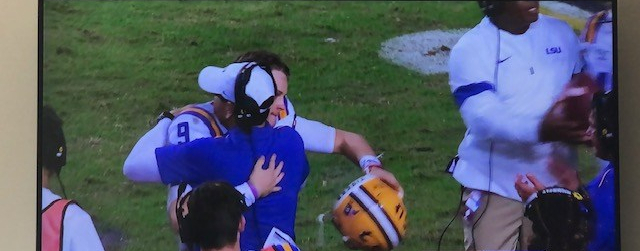
When I’m not sleeping, I find it fascinating to study team dynamics – on the sideline, on the field, and before/after the game. It’s the nuances that fascinate me – body language, congratulatory helmet pats, spontaneous multi-player end zone dances with the guy who just scored, direct and impassioned “feedback” between the coach and a player to correct the latest on-field mishap, and the guys who signal their need for privacy with a towel draped over their head on the bench. 

During a recent conversation with a high school football coach, I was fascinated to learn about the weekly routines that lead up to and follow Friday night games. From team meals and rituals, to the intricacies of film viewing, to 1:1 coaching sessions to critique recent performance, to coaches’ planning sessions scrutinizing every move and dynamic of the game… all toward the goal of ensuring that  every member of the team is well informed and equipped to be better together the following week. 

As an educational leader, I can’t help but look for parallels between the gridiron and the department office. If you look closely, they’re definitely there.

  • As goes the coach, so goes the team. This principle requires leaders/coaches to take a long look in the mirror. Culture is what a leader allows. What is affirmed, what is allowed, and what is disallowed by the leader all add up to the culture of the team – for better or for worse. A boss/coach who sees only the negative creates a safe place for a team who does the same. A boss/coach who seeks out behaviors to affirm and uplift will find many more reasons to do so as this positive culture takes root.
  • Communication, communication, communication. Much like the old real estate mantra “Location, location, location,” communication makes or breaks well functioning teams. A friend once said that quaLity time can only grow out of quaNtity time.  The fertile soil of quantity time produces a rich harvest of quality communication between individuals. What kind of quality time does your team share – team dinners, team building experiences, informal time together outside of work (electronically or in person), time for reflection and celebration? Or rushed interactions, siloed efforts, competitive behavior, and more content in the ‘meetings after the meetings’ than in the meetings themselves? 
  • The “have my back” factor.  In nearly every game, some guy gets an unnecessary shove and immediately the 4 teammates within arm’s length are bowing up to the offender to ensure that he sees the error of his ways. In healthy organizations/teams, a (hopefully) less physical equivalent can also be found. Do you know that your colleagues will come to your defense if someone is talking behind your back? Do you know that your colleagues will presume positive intent if they don’t understand your actions? Do you have faith that if someone doesn’t understand your choices they’ll come to you directly rather than letting misinformation fester and friction take root? This kind of teamwork takes bravery and commitment to each other and the collective goals of the group, but it’s the only way a team will ever perform at high levels.
  • The opportunity to fail. During an interview on ESPN’s game day, the energetic coach, P.J. Fleck, of Minnesota’s highly ranked team was asked what he thought led to their historic season.  He described the experiences they have had over the last couple of years during his tenure when they had the opportunity to fail. They failed and failed and learned and learned through each defeat.  He credits this as the reason for their team’s turnaround. Not every team will be healthy.  But every team experience offers an opportunity to learn. Some of my best leadership lessons have been taught by leaders I don’t want to replicate or team members I haven’t trusted. My growth as a leader and team player has been informed as much by my unpleasant experiences as my positive ones. The trick is to choose to use these negative experiences as teachers.
  • Human team vs. Jersey team. It’s always interesting to see whether the opposing team’s players help each other up after a brutal tackle. Do players from both teams express genuine concern for an injured player? Is anyone spotted helping out by doing jobs or cleaning up beyond that which would be expected of them? In other words, are members only looking out for themselves or are they there for the betterment of the game? These behaviors may not add up to points on the board (or whatever metric the team uses as a measure), but they speak volumes about the character of the individuals on the team.

I can understand if, for some, it’s a big stretch to compare the full contact sport of American football to the operational dynamics of a well-functioning leadership team. But next time you prepare to doze off on the couch with the roar of the crowd in the background, watch the sidelines. You might be surprised at what you can learn that may be helpful on Monday morning.