
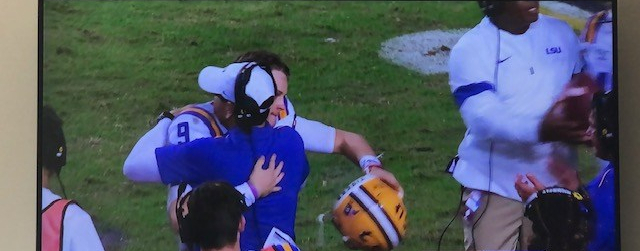
During the fall, on any Thursday through Monday evening, it’s a safe bet that my house will hum with the music of crowd roars and commentators. In the same way that orange leaves signal fall and stores full of Santas signal Christmas, the first kickoff in August signals a series of Saturday couch naps with games on the TV as background music.
When I’m not sleeping, I find it fascinating to study team dynamics – on the sideline, on the field, and before/after the game. It’s the nuances that fascinate me – body language, congratulatory helmet pats, spontaneous multi-player end zone dances with the guy who just scored, direct and impassioned “feedback” between the coach and a player to correct the latest on-field mishap, and the guys who signal their need for privacy with a towel draped over their head on the bench.
During a recent conversation with a high school football coach, I was fascinated to learn about the weekly routines that lead up to and follow Friday night games. From team meals and rituals, to the intricacies of film viewing, to 1:1 coaching sessions to critique recent performance, to coaches’ planning sessions scrutinizing every move and dynamic of the game… all toward the goal of ensuring that every member of the team is well informed and equipped to be better together the following week.
As an educational leader, I can’t help but look for parallels between the gridiron and the department office. If you look closely, they’re definitely there.
- As goes the coach, so goes the team. This principle requires leaders/coaches to take a long look in the mirror. Culture is what a leader allows. What is affirmed, what is allowed, and what is disallowed by the leader all add up to the culture of the team – for better or for worse. A boss/coach who sees only the negative creates a safe place for a team who does the same. A boss/coach who seeks out behaviors to affirm and uplift will find many more reasons to do so as this positive culture takes root.
- Communication, communication, communication. Much like the old real estate mantra “Location, location, location,” communication makes or breaks well functioning teams. A friend once said that quaLity time can only grow out of quaNtity time. The fertile soil of quantity time produces a rich harvest of quality communication between individuals. What kind of quality time does your team share – team dinners, team building experiences, informal time together outside of work (electronically or in person), time for reflection and celebration? Or rushed interactions, siloed efforts, competitive behavior, and more content in the ‘meetings after the meetings’ than in the meetings themselves?
- The “have my back” factor. In nearly every game, some guy gets an unnecessary shove and immediately the 4 teammates within arm’s length are bowing up to the offender to ensure that he sees the error of his ways. In healthy organizations/teams, a (hopefully) less physical equivalent can also be found. Do you know that your colleagues will come to your defense if someone is talking behind your back? Do you know that your colleagues will presume positive intent if they don’t understand your actions? Do you have faith that if someone doesn’t understand your choices they’ll come to you directly rather than letting misinformation fester and friction take root? This kind of teamwork takes bravery and commitment to each other and the collective goals of the group, but it’s the only way a team will ever perform at high levels.
- The opportunity to fail. During an interview on ESPN’s game day, the energetic coach, P.J. Fleck, of Minnesota’s highly ranked team was asked what he thought led to their historic season. He described the experiences they have had over the last couple of years during his tenure when they had the opportunity to fail. They failed and failed and learned and learned through each defeat. He credits this as the reason for their team’s turnaround. Not every team will be healthy. But every team experience offers an opportunity to learn. Some of my best leadership lessons have been taught by leaders I don’t want to replicate or team members I haven’t trusted. My growth as a leader and team player has been informed as much by my unpleasant experiences as my positive ones. The trick is to choose to use these negative experiences as teachers.
- Human team vs. Jersey team. It’s always interesting to see whether the opposing team’s players help each other up after a brutal tackle. Do players from both teams express genuine concern for an injured player? Is anyone spotted helping out by doing jobs or cleaning up beyond that which would be expected of them? In other words, are members only looking out for themselves or are they there for the betterment of the game? These behaviors may not add up to points on the board (or whatever metric the team uses as a measure), but they speak volumes about the character of the individuals on the team.
I can understand if, for some, it’s a big stretch to compare the full contact sport of American football to the operational dynamics of a well-functioning leadership team. But next time you prepare to doze off on the couch with the roar of the crowd in the background, watch the sidelines. You might be surprised at what you can learn that may be helpful on Monday morning.
 The Second Half Blog