
The more I reflect on the COVID-19 crisis, the more thoughtful I’ve become about how I spent the evening of March 12th. On this night, a dear friend and I spent a couple of hours experiencing a musical, Come From Away, at the Music Hall at Fair Park. Any other year, spending a mid-March evening with a friend at a musical would be unremarkable. This year, for reasons that anyone alive right now can imagine, enjoying a musical on that date in a public place in the pre-social distancing era earns remark.
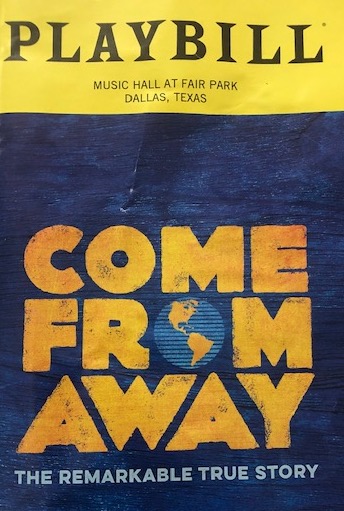
This musical tells the story of 7,000 airline passengers who were unexpectedly grounded for six days in Gander, Newfoundland, a town of only 10,300 people, while traveling across the Altantic on the morning of 9/11/01. I’d read a book, The Day the World Came to Town, by Jim DeFede, a few years ago which detailed the story upon which this musical was based. It provided a fascinating narrative that left me moved by the power of the human spirit, the kindness of total strangers, and the ability for relationships and community to form out of times of crisis. As I sat in the audience that night, on edge for the sound of anyone coughing or appearing sick near where I was seated in the crowded theatre, I began to wonder. Could the drama surrounding the biggest crisis in my lifetime to this point – September 11, 2001 – be on the brink of being repeated in a new way nearly 19 years later? I distinctly remember wondering whether the events unfolding in March of 2020 would someday become a musical I’d go to see.
Engrossed in the Come From Away story, I fell in love with the characters. The shock of the world’s change that unfolded for them in waves of unbelievable news, the way they grappled with the devastation and personal connections to death and destruction, the diversity of people whose only common act was flying aboard one of the 38 planes which had to land on the small island that fateful day, and the genuine and selfless love offered by the humans who opened their arms and homes to the distraught passengers. It was the kind of show that makes you want to make friends with all of those who walk past you during intermission.
One of my biggest takaways from the musical was the capability of humans to rise above difference to survive in difficult circumstances. If ever our world has needed to experience this again, it is in 2020 – not just in Gander, but in Grapevine, New York City, Washington D.C., Stillwater, Hong Kong, Paris, and every other corner of the world. Political divisions, racial divisions, religious divisions, and the general tendency toward judgement rather than empathy has tempted me to lose faith in the world my children will inherit.
While I had no way of conceiving what the next few hours, days, and weeks could have held, Come From Away made me wonder what impact the looming COVID-19 pandemic could have on society. Seven weeks into a near-complete societal closure, I’m starting to see the answers.
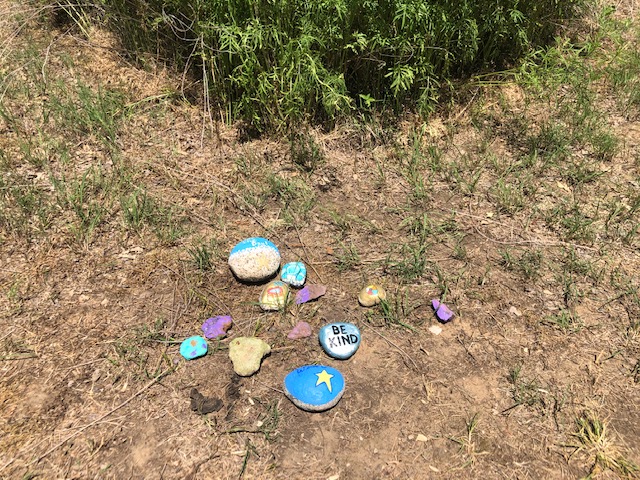
On my 2-3 daily walks around town, people wave. They smile….earnestly. As if genuinely wanting to see me and connect. Today on a walk along a pathway in the woods near my house, all walkers shared a kinship. A teenager biking alone slowed down and said “How are you today?” And he waited for my answer. A mother of 5 children – two in a stroller, two on scooters, one on a bike with training wheels – walked wearily down the path and chatted gratefully as my friend and I applauded how well she was doing with a small classroom of a family. At the park we passed, several dads were pitching balls to young children who tried hard to connect the bat. Freshly painted rocks with messages of hope adorned a fork in the path.
The U.S. mail service has actually delivered letters to my house and the houses of many I know. Real letters. Not just bills or perfunctory holiday announcements or catalogs. I’ve received kind, handwritten sentiments from those within my daily circle and those who I’ve not seen in years. The inability to connect in physical spaces has brought about more intentional connection via the mail, phone calls, porch drop-offs, virtual web meet-ups, and more. People clearly need each other. And the people with whom I’m connecting are not talking about politics, or race, or religion (although God and our need for His help has often been a subtext). They’re talking about how we’re doing. Care and concern about heatlth, ample food and toilet paper (seriously), and worries about anyone who may be lonely or in any type of danger.
My family of 4 is cohabiting under one roof for multiple weeks for the first time since mid-2017. During the fall of 2016, we downsized homes in somewhat early anticipation of being empty nesters. We built the house in a way that my two daughters could come back and visit for a few nights and not be uncomfortable, but we failed to anticipate a need for space to accomodate 4 people working on simultaneous Zoom and Webex calls during the day who would need to agree on one TV program in the evening. But we’ve managed. In fact, most of the time, we actually like each other. I feel like I now know my adult daughter in a way I hadn’t known her when she last shared my address. Her college classes I’ve eavesdropped on are HARD. And she knows how to do all these things no one in my family could have taught her. And she gets up and “goes” to her classes conscienciously. She’s missed her college life and the independence that came with it, no doubt, but she’ll be a great adult. I also now feel more confident sending my high school senior into the world of college because of what kind of human I’ve now seen her be. Yes, I lived with her daily for 17 years. But between her school and social schedule and my work and adulting schedule, I can count on two hands the number of truly quality minutes we’ve had together daily during the past year. The pandemic changed this. I now know her self-discipline, her integrity, her compassion, her study habits, and her needs. She’s going to be such a great college student and future adult. I know this now in a way that I wouldn’t have gotten to see before the world came to a screeching halt.
And the teachers… both the ones who have degrees and certificates on the wall and the ones whose normal titles are Mom or Dad, Sister or Brother, Grandma or Grandpa. All of these saints, learning how to make sure the routines for children’s learning continue in the face of nearly impossible circumstances. They are the ones dealing with motivational issues, correcting papers, tantrums, routines, tech challenges, balancing learning time with recess… all while possibly trying to hold down a virtual day job and processing the fear and uncertainty that every day’s news brings. But they’re doing it. Even my district’s campus with the most students in economic need has been able to connect with every single child. Families are struggling, but more than ever, the fabric of public education is being revealed as one of the great safety nets of our civilized society. Education will never again be the same after COVID-19, but in many ways, it may be improved and most definitely more appreciated.

My garden is growing. Every day I get to see new sprouts like the leaves of spinach growing outward in a way I never appreciated when my pre-washed salad was pulled out of a bag. I’m eagerly anticipating the varieties of tomatoes that will soon be ripe, and I can’t wait to share them with my neighbors who are also talking to me about my garden on their daily walks. I noticed a fox pacing my backyard yesterday while I looked out the window during a Webex call. He seemed perfectly at home. It occurred to me that he may be more at home than I’ve ever taken the time to realize. It’s me who is the newcomer to the property on a weekday afternoon.
Strangers are being kinder to each other. Last year, after a few examples of vitriolic tirades against my hard-working school district colleagues on the Nextdoor App, I’d stopped perusing it. One night last month I saw a notification about an area closure that caught my attention, so I clicked. Pleasantly surprised, the first post I saw came from a resident who needed help picking up groceries because of his underlying medical condition. Within a few hours, 26 strangers had responded with offers of porch drop-offs, donations, and other services. Thinking this to be an isolated instance, I scrolled on and saw several more examples of the app becoming a hub for neighborhood exchanges, offers of help, and encouragement.
Many awful statistics characterize the current crisis. The number of those infected and those who have lost their lives is staggering. The unemployment numbers, sales tax revenues, oil prices, and countless other measures have and will continue to have a devastating effect on the U.S. and world economies. Many have lost their homes and have food insecurity in numbers not seen since the Great Depression. These circumstances terrify me and keep me up at night wondering how to help or what the ripple effects will be for years to come.
Not being able to control any of the items listed in the prior paragraph is a source of great anxiety. I wonder if the real life community members of Gander, Newfoundland felt the same way. All they could do is put one foot in front of the other and show up as a human each day, working together and trying to do the next right thing. One day, the science will catch up with the crisis. One day, we’ll have a vaccine. One day, we might just have a musical about the COVID-19 pandemic. I hope the steps I take each day will make it one to inspire others, one that will show the good in humanity, and one that will reveal what is possible. Let’s pre-order our tickets.
 The Second Half Blog
Thank you! That made me feel better to read that. This is a monumental time. In the wake of horrific news, dire, economic circumstances, and the fear of uncertainty of how the world has, or will ,change, going forward, it’s great to be reminded of how good humanity can be when challenged with great adversity all around us.
LikeLike